Thursday, June 22, 2006
SW Methodology - Shaolin Style
One advantage of blogging is that it enables you to articulate your vague inchoate thoughts more coherently and more importantly, it enables you to develop your thinking. After ranting about the inappropriate use of TDD, I've been able to develop my insights further. Expressing ideas helps to form them as Paul Graham says.
The most fruitful way to think of any pre defined software methodology seems to be that is an encoding of certain practices intended to teach you certain lessons.
In Karate (or any martial art) there are sequences of fixed movements called kata. In music, there are fixed forms called "etudes" (in western music. A rough analogue would be the varna in (South)Indian classical music). Conceptualising a methodology as an "encoding" of what worked for certain people in certain situations is an alternative to "methodology as religion"
The practitioner of a kata (or etude) seeks to perfect each component of the larger structure (a punch in a kata, a particular phrase in an etude) and since absolute perfection is elusive, the practice may go on for years or a life time.
If one thinks of the 12 practices of Extreme Programming (say) as forming a "fixed form" that teaches certain principles of software development (vs as some kind of sanctified system of "rules to follow or you'll burn in hellfire") then it becomes easy to both strive for perfection of each component (say unit tests) while practising, and modifying or discarding the same component during performance as need demands.
Combat is different from kata practice in a dojo. When you are in a dark alley facing someone who tries to gut you with a knife, the important things is to win that fight, not conform to the structure of the kata. When you are practising the kata, the idea is not be creative and do "free flow" but to focus on mastering the form exactly as expressed in the kata. The immediate goal of kata is "perfection of the form" (and the lessons learned therefrom) not "effectiveness in attaining the ultimate purpose".
Guitar Etudes have odd fingerings and chord sequences which will never make it into a lead solo. But when you practice the etude you do what the notation says , not what might best express your musical intent or satisfy an audience. While practising, a gutar maestro will be able to perform an etude perfectly as written in the notation, awkward fingerings and all, but when he is on stage, improvising a solo, he really doesn't think of "exactness of fingering". He focusses on musical effect and allows his fingers to go where they will.
Once you accept that a set of rules telling you how to develop software is just a "fixed form", it is easy to discern the two errors that software methodology practioners (not to mention the "evangelists" who have found the "One True Path") consistently fall into.
The first error is to apply the criteria of practising the form to the performance. iow, to insist that you should fight only using the movements of the kata you learned. "Ohhh you are not writing a test, you are not Agile... Code without tests is 'legacy code' Shame on you ".
The second, and more subtle, error is to apply the criteria of performance to the practice of the form, ie you treat the kata as a combat situation. "Aargh writing tests for javascript is impossible so I won't write any tests because obviously this unit test stuff is impractical" or " Writing tests means I write more code so I will be slower. So I will never write any tests".
Of late there have been some attempts to use the underlying principles of "kata" to improve software development skills. This is the "practise the form perfectly in a non combat situation" approach.
What has been missing is the more important second half -- "combat is not kata". In a hypothetical combat situation, in that dark alley with someone lunging at you with a knife, it isn't very important that you take up the perfect "horse stance" and then do a perfect roundhouse kick. If you end up in hospital, leaking blood from half a dozen stab wounds it doesn't matter if you "took the stance perfectly". As Bruce Lee once said "On the street, no on knows you are a black belt".
In the alley, facing a knife thrust, using a garbage can lid to block the knife and knock the attacker out cold will work fine, nevermind that in Shotokan Karate there are no "Garbage Can Lid Kata".Of course if you've practiced your forms (and other practices like kumite) well for many years, you won't be sweatily flailing around, panting for air and driven by adrenaline, like an untrained person will. You will be in control, using the minimal amount of movement and force and stay balanced all the time , and be aware of things like distance, force, balance, vector of attacks and so on.
You can even learn something from the combat situation and incorporate it into your practice ("hmm fighting in the dark in a cluttered alley is quite different from sparring in well lighted uncluttered dojos so how do I learn to fight better in such conditions?"). Who knows, you may be able to distill your experiences to create a "dark room kata" for others to learn from. And the practitoiners of this "dark room kata" wil in turn diverge from its fixed patterns in their own combat situations. And that is exactly as it should be.
One problem with software development is that "practise" and "performance" are mixed up thoroughly. Both generally happen within the context of a project someone else is paying for. A software developer learns "on the job". It is often impossible to change this state of affairs, but it is helpful to distinguish the "practice" and "performance" aspects , the kata and combat, the etude and the concert.
When you are learning extreme programing, do exactly what Kent Beck teaches in the "white book". When you are actually developing software it doesn't matter if you aren't "exact". If you have difficulties in applying a particular practice, make note and use what works. Later you can think of whether the problem is one of insufficient practice of the technique (in which case you practise more) or whether the technique itself is a misfit for your circumstances (in which case you modify the technique or discard it entirely). There is no intrinsic merit in force fitting the combat situation into the framework of your "school" of fighting. You'll just get stabbed.
There is no "perfect kata" which will reward rigid adherence with universally victorious combat ability. There is no "perfect methodology" which will guarantee success if it is followed "perfectly". Extreme Programming (to use one particular methodology) is not magic. Is is just the encoding of what Kent Beck (and others) learned by trying to get better in the projects they worked on. By all means learn from Kent. Don't worship him (or XP). Ignore the high priced consultants. Your situation and requirements are likely different from what Kent faced. Nobody cares what methodology you follow as long as you write code that delivers value. Arguments about "Shotokan Karate is better than Shaolin Kung Fu" are on the same level as "XP is better than RUP (or waterfall for that matter)".
Combat is not practice. A dojo is not an alley. And vice versa.
Tuesday, June 20, 2006
The 'Cult Of the MBA'
In Joel Spolsky's article, there is one sentence that wish I had written
The cult of the MBA likes to believe that you can run organizations that do things that you don't understand.
On second thought though, the ideas behind that sentence look a little bit more complex than they appear. I have seen managers (used interchangeably with "folks who have mbas" for the rest of this post) have made a (positive) difference. Maybe it is just that competent people, with or without an MBA, do make a difference in situations including them. So the question becomes "Is there a significant differential advantage conferred by an MBA?" Somehow I doubt it.(I am talking of differntials of capability, not differntials of social standing or ability to climb organizational ladders) I have seen too many clueless morons with MBAs screw up situations behind repair.
Taking another vantage point, for a company that is essentially about doing cutting edge, innovative things (with or without software) and redefining the way the world works, it would be insane to hand the driving wheel over to a (non engineer) MBA. Which is probably why Larry and Sergei agonized over selecting their CEO for so long, and why Jobs is btter for Apple than Sculley. OTOH if company is involved in "software services" or "offshoring" or whatever, maybe its makes sense to hand over the reins to an MBA who can then 'manage "resources" ',"scale up operations" etc.
And anyway "cults" are not confined to MBAs. On the geek side of the fence we have the Cult of Apple, The Cult of Agile etc. Nothing new here folks, move right along.
I do NOT use Yahoo 360
so please don't "add me as a friend" in Y360 :-)
I get 2 or 3 mails everyday saying that "Mr/Ms X has requested that you add them as a friend". The thought is appreciated. Seriously. but there is NO point in adding you guys to an account I do not use.
I use practically nothing from Yahoo except a webfacing email id and Yahoo messenger and the latter is for historical reasons, not because I am impressed with its quality. Those of you who know me enough to be "added as friends" please use either my gmail id or ping me on yahoo messenger or skype or... :-) .
I hope I didn't come across as arrogant but I really do NOT like yahoo's flashy ad riddled pages or its Y360 service. Please understand. Thanks in advance.
:-)
Monday, June 19, 2006
Compilers, TDD, Mastery
I was talking to a friend yesterday about the upcoming compiler project when he asked me a question "Will you be coding the compiler in an Agile fashion? I mean using TDD etc?". This turns out to be an intriguing question.
I got sick of the "silver bullet" style evangelization of the Agile Religion and formally gave up "agile" some time ago. However I do believe in programmer written unit tests being run frequently and that is part of "agile". What I do not believe in is the notion of the design "emerging" from the depths of the code like the Venus of Milo from the waters by just repeating the "write-test, write code, refactor" cycle, a practice otherwise known as TDD.
Anyway, I decided to google for compiler s and tdd and came up with some absolute gems.Here's the first.
On the comp.lang.extreme-programming mailing list, I came across this absolutely hilarious exchange.
In the midst of a tedious discussion on whether XP scales to large projects, "mayan" asked,
I am not asking what kinds of companies are doing XP work - I believe a lot of them are, and successfully. What I am asking is anyone using XP for large size/high complexity/high reliability problems. To be more specific - stuff like optimizing compilers, OS kernels, fly-by-wire systems, data-base kernels etc
Ron Jeffries, one of the "gurus" of agile, replied,
. I'm not aware of any teams doing compilers or operating systems using XP, but having done both, I'm quite sure that they could be done with XP, and the ones I
did (at least) would have benefited from it, even though they were successful
both technically and in the market.
Aha this looked interesting! Someone actually thinks a compiler can be written in a XP (and presumably TDD) fashion. Mayan issued a challenge to Ron which looked like this
Excellent: lets talk about the following problem: write an optimizing
back-end for a C compiler (assume we purchased the front-end from
someone). How would we use XP, or adapt XP to it?
Some problems with compiler back-ends:
- its fairly clear what has to be done (core
{intermediate-language/instruction
selection/register-allocation/code-generation} + set of optimizations);
its fairly clear what order they have to be done in (first the core,
then a particular sequence of optimizations)
- you don't really need customer input. Having a customer around doesn't
help.
- you can't demo very much till you have a substantial portion of the
code written - the core (say about 30-60klocs) - no small (initial)
release
- you had better get your IL (intermediate language) data-structures
right - if you pick ASTs or 3 or 4 address form, you will do fine for
the basic "dragon-book" optimizations, but later on you will either run
into severe problems doing more advanced optimizations, or you will have
to rewrite your entire code base [probably about 100-150klocs at this
time]. Is this BUFD?
- you had better think of performance up front. Toy programs are easy;
but a compiler has to be able to handle huge 100kloc+ single functions.
Many heuristics are N^2 or N^3. Both run-time efficiency and memory
usage end up being concerns. You can't leave optimization till the end -
you have to keep it in mind always. It also pretty much determines your
choice of language and programming style.
- TDD may be applicable for some of the smaller optimizations; on the
other hand, for doing something like register-allocation using graph
coloring, or cache blocking - I wouldn't even be able to know where to
begin.
- The basic granule (other than the core) is the optimzation. An
optimization can be small (constant propagation in a single basic block)
or large (unroll-and-jam, interprocedural liveness analysis). The larger
ones take multiple days to be written. Integrating them "often" is
either pointless (you integrate the code, but disable the optimization)
or suicidal (you integrate the code, but it breaks lots and lots of
tests; see below). Best case: integrate once the optimization is done.
- Its not easy to split an optimization into subproblems; so typically
one (programmer/pair) works on an optimization. For the larger ones, if
it needs to be tweaked, or fixed, the unit that wrote it is the best
unit to fix it. The overhead to grok a couple of thousand lines of code
(or more!) vs. getting the original team to fix it is way too high.
- Testing, obviously, is a lot more involved. Not only do we have to
check for correctness, we have to check for "goodness" of the produced
code. Unfortunately, many optimizations are not universally beneficial -
they improve some programs, but degrade others. So, unit testing cannot
prove or disprove the goodness of the implementation of the
optimization; it must be integrated with the rest of the compiler to
measure this. Further, if it degrades performance, it may not be a
problem with that optimization - it may have exposed something
downstream from it.
- Typical compiler test suites involve millions of lines of tests. They
tend to be run overnight, and over weekends on multiple machines. If you
have a badly integrated optimization, you've lost a nights run. And
passing all tests before integration is, of course, an impossibility.
Even a simple "acceptance" set of tests will check barely a small
percentage of the total function in the compiler.
Hmmm.....does this still look a lot like XP to you? I can see that at
least 1/3rd of the XP practices being broken (or at least, severely
bent).
Based on your experience, do you disagree with any of the constraints I
outlined?
Mayan
I expected Ron to post a reply explaining how all the above can fit into the Agile/XP framework, but there was only [ the sound of crickets chirping].
On the XPChallengeCompilers page, Ron repeats his claim that "I've written commercial-quality compilers, operating systems, database management systems ". Hmm. Yeah. Whatever. He doesn't make any useful points about how one would actually go about doing something like this.
On the same page, Ralph Johnson has (as one would expect) a more thoughtful and articulate view point about how XP would apply to writing a (simple) compiler, but he focusses more on the fact that " DoTheSimplestThingThatCouldPossiblyWork is true for compilers, as well. My problem is that people seem to think that the simplest thing is obvious, where my experience is that it is often not obvious. One of the things that makes someone an expert is that they KNOW the simplest thing that will really work."
Now this makes sense. There is no hint of the design "emerging" from "average" developers grinding through the tdd cycle and there is a strong hint that you do have to understand the domain of a compiler well before you can even conceive of the "simplest thing". He concludes with "The XP practices will work fine for writing an E++ compiler. However, I think there will need to be some other practices, such as comparing code to specification, as well as appreciating the fact that you sometimes must be an expert to know what simple things will work and which won't".. Ahh the blessed voice of rationality.
Another area where Agile falls flat on its face is when dealing with concurrency. See the XP Challenge concurrency page for the flailing attempts of an "agilist" to "design by test" a simple problem in concurrency. Tom Cragill proposed a simple synchronization problem and Don Wells (and some of the agile "gurus") attempted to write a test exposing the bug and didn't succeed till Tom pointed the bug out.
Coming back to compilers, there are projects like the PUGS project, led by the incredible Autrijus Tang, in which unit tests are given a very high priority. I couldn't find any references to the PUGS design "evolving" out of the TDD cycle however. It seems as if they build up a suite of programmer written tests and run it frequently.I can see how that practice would be valuable in any project. Accumulating tests and an "automated build" are the practices I retained from my "agile" years. AFAIK the pugs folks don't do "TDD", expecting the design to emerge automagically.
This whole idea of "emergent design" (through TDD grinding) smacks of laziness, ignorance and incompetence. Maybe if you are doing a web->db->web "enterprise" project you can hope for the TDD "emergence" to give you a good design, (well, it will give you a design :-P) but I would be very surprised if it worked for complex software like compilers, operating systems, transaction monitors etc. Maybe we should perusade Linus to "TDD" the Linux kernel. TDD-ShmeeDeeDee! Bah! :P
Update: Via Jason Yip's post, Richard Feynman's brilliant speech exposes what exactly is wrong with the practice of "Agile" today. An excerpt
I think the educational and psychological studies I mentioned are examples of what I would like to call cargo cult science. In the South Seas there is a cargo cult of people. During the war they saw airplanes with lots of good materials, and they want the same thing to happen now. So they've arranged to make things like runways, to put fires along the sides of the runways, to make a wooden hut for a man to sit in, with two wooden pieces on his head to headphones and bars of bamboo sticking out like antennas--he's the controller--and they wait for the airplanes to land. They're doing everything right. The form is perfect. It looks exactly the way it looked before. But it doesn't work. No airplanes land. So I call these things cargo cult science, because they follow all the apparent precepts and forms of scientific investigation, but they're missing something essential, because the planes don't land.
Saturday, June 17, 2006
[DevNote] Interpreter To Compiler
I generally use a wiki (moinmoin in case anyone is interested) on my laptop to keep notes on various projects I work on. However the wiki has not been transferred from my old laptop to my new one. With all the travellng I am doing, this won't get done till the next month or so. Meanwhile I'll use this blog to record (some of) my dev notes (when i can get net access ...sigh.....). Since Blogger doesn't support tagging or categories, I'll prepend a "[DevNote]" string to the title of the post so readers can ignore the post if they wish. These notes are likely to be cryptic and incoherent and most readers should just skip them.
To transform an interpreter to a compiler,
- Rewrite interpreter in CPS form.
- Identify Compile time and Runtime actions(CPAs and RTAs)
- Abstract RTAs into separate 'action procedures'.Use thunks to wrap any weird control structures where necessary
- Abstract Continuation Building procedures (CBPs)
- Convert RTAs and CBPs into records. Now the eval on the parse tree spits out a datastructure.
- Write an evaluator for the resulting data structure making sure to (a) implement register spilling (b) 'flatten' code to generate "assembly like" code.
- TODO : investigate the pros and cons of Bottom Up Rewriting Systems (BURS) vs the scheme above vs generating a (gcc) RTL like intermediate language
- TODO : investigate the effects on stack discipline and garbage collection when the various schemes are adopted . Which is more convenient?
Thursday, June 01, 2006
StockHive goes live
I am still internet challenged and will be offline for the next month or so, but this is worth commenting on.
My friend Yogi has launched StockHive, an online tool for folks investing in India's stock markets.
If you are an investor, you should definitely look at StockHive. For the techies amongst you the site is built on Rails.
Thursday, May 11, 2006
Blog Lockdown
I will be travelling for the next couple of months and will have zero network access. Athe commenting facility on this blog have been disabled. I will re enable them when I get back to civilization in mid July.
Au Revoir

Wednesday, May 10, 2006
The Decline and Fall Of India
The present government has proposed an utterly idiotic caste-based reservation in higher education and in private industry. In other words, get ready to fill in a religion/caste form to determine if you'll get an IIT admission, get a job, get promoted etc.
Atanu says it much better than I can. Read. Learn.
Well, I vote with my feet. I am getting out of this stupid country next year.[tongue attached to cheek mode on]I wonder if China issues citizenships to foriegners. Of course I'd be arrested in 10 days for "anti communist beliefs" but it would be fun while it lasted. Might be worth considering if China ever became a democracy[tongue attached to cheek mode off]
Monday, May 08, 2006
Abandoning Agile
My friend Yogi said in a chat session recently, "I havent seen your blog entry renouncing all things agile!"
Yogi, your wish is my command. here it is.
Bill Caputo said it much better than I ever could. So I'll borrow from his blog entry.
"...In short,... I am formally retiring from Agile Evangelism (something I lost the heart for some time ago), and simply becoming an Agile Private-Citizen. Thus, I expect that the tone of my writing will shift somewhat as I no longer care (and truthfully haven't for some time) whether the world adopts XP -- or even whether anyone does -- I am simply interested in building software to the best of my ability, working with others of like mind, and flat-out outperforming others using the techniques and tools that I have learned how to use over the past several years. That anyone familiar with XP would immediately recognize its strong impact on the nature of our software development project is almost (but not quite) irrelevant to that goal. ..."
Of course the difference between Bill's position and mine is that he still continues to use XP. He just doesn't evangelize it. The kind of problems on which I'll be working for the rest of the year (and hopefully, for the rest of my life) shift the context of development so much that most of the practices and assumptions of XP/Agile just don't make sense anymore. The only surviving practices are the constantly growing test suite (no more test first) run periodically and a very attenuated Continous Integration step. Where Bill is an Agile Private Citizen, I am an Agile Ex-Citizen.
I have also stepped out of the Agile Software Community Of India, a non profit society of which I am a founding member. I may still need to attend one final meeting to elect the next year's office holders, and help resolve some residual organizational issues but that's it. I am done with all things Agile.
It is a great relief. Agile is "hot" these days and all sorts of weirdos crawl out of the wooodwork to scramble on the "Agile" platform and caper and scream to attract "agile consulting" assignments. The politics is sickening. Now I can just shut these folks out and focus on what is more important, writing good software.
Sunday, May 07, 2006
Grounding "exotic" technology - The Banker's story
The machine learning system I was called in to design for a Telecom Fraud detection company is moving into production. I was told yesterday that the testing folks are "amazed at the high accuracy of the new codebase" and my client is extremely satisfied with the improvements. I was really happy to hear this. Nothing makes a programmer happier than news that his code/design is making a substantial contribution in the domain for which it was written.
My clients were leaders in their domain even before we added the new ML capability. With the enhancements (not limited to the fraud detection engines, they've added a lot of functionality in other areas) they should wipe the floor with the competition. None of their competitors has a fraud classifier system as powerful. And we have implemented only a small fraction of what could be done.
This datapoint just confirms by belief that powerful technology allied to a strong management vision can lead to massive value addition. What made the difference is the adoption of a key metric(erroneous classification/million cell phone calls) as the measure of the software's quality and the almost total freedom given to the implementation team (which included some of the best folks in the company). We had NO political or turf battles and the laser like focus of the manager in charge on the key metric helped us to evaluate alternate strategies and select the most appropriate ones. This (tying the software developed to key business metrics) is one way of "grounding" business software and preventing thrashing. (More explanation of this conmcept coming up in future blogs).
Back to Banking. One of the nuggets that came out of our conversation(see last blog) was the fact that most Indian banks still do manual verification of signatures on cheques. This has been automated to a large degree a long time ago in most banks in the West. The algorithms for this are available in the literature. Large chunks of software that made up the original solution are publicly available. All it needs is for someone to put together a hardware/software combination to provide this functionality and the banks would jump at it.
Why is this important? Here is the Industry context. In 2009, the Indian Banking sector will be opened to Foreign banks . (It is semi-open right now). That would mean(assuming India is doing well economically) that tidal wave of foreign banks would arrive and the existing banks would face real competition.
The scariest part of this impending shift in the landscape, from the point of view of Indian Banks is the massive technological advantage that western banks enjoy (relative to the Indian banks). And in the Indian banking scenario, market share is almost directly in proportion to the technology level of each bank.
Here is an example. For years, only ICICI offered an "at par cheque" facility, ie, the ability to present a cheque drawn on an account in another city and get it cashed instantaneously (vs. waiting for few days for the cheque to be couriered to the city in which the account resides). Thousands of businessmen did not have an alternative but to bank with ICICI because no one else had anything similair.
By the time the other banks caught up with this technology, ICICI came up with a feature by which transfers between accounts could be transacted on the net (even if the target account was in another bank). As of today no one else has this feature(unless they go through ICICI) and this gives them an edge.
I forget the domain term for this. But the point is that the ranking in the technical arms race almost directly determines the marketshare. And this marketshare is what is under threat when the big boys land with their deep pockets and massive mainframes. So even something as simple as automated cheque signature verification could provide an edge in the impending blood bath in the banking sector.
So there. Now you have an idea on how to make millions. If you do, cut me a cheque for the idea. :-)
A Thought Experiment
I recently had a conversation with a friend who works in ICICI, one of the largest banks in India. Contrary to my "image" I am deeply interested in Business and the "enterprise"; I belive the practice of outsourcing the software at the heart of an enterprise to body shops flogging mediocre programmers is indefensible. My friend was kind enough to enlighten me on how banking really works and the context in which Indian Banking operates. The next few blog entries will be devoted to insights which spun off rom that conversation. First though, I'd like to focus on the gaps between image,ideal and reality
As with all industries (e.g the outsourced software "industry") there is an image, ("intellectually challenging work done by extremely bright people trying to change the world" in the case of the Indian software industry) which people outside the industry believe and a not-so-cool reality which only insiders are aware of. The reality of India's software "industry" is that most "hackers" working in it are comparable to the illegal immigrants from Mexico who come to swanky Wall Street offices early in the morning to vaccum and dust. The difference is that the average mexican immigrant who does these jobs does not fool himself into thinking he is doing "cutting edge" work.
The interesting thing is that beyond these two perceptions ("What does IndustryX look like from the outside?" and "What is IndustryX really like (from the inside)?") there is another question "What could IndustryX be like if we tried to really deliver superior customer value and create first class working environments and did first class work?".
Very few companies are trying to envision and implement the last question in any industry,whether it be software, banking or anything else.
Let us do a thought experiment and envision a future in which India did less of the "janitorial" programming, and becomes a true "software super power". In such an imaginary point in the multiverse,
- India would be home to innovative companies like (say) Apple and Google .
- At least one popular language (like, say, Ruby), Operating Sytem (like Linux) , or widely used tool (like say, emacs) would be invented by an Indian. .
- People all over the world would expect a newly announced fantastic advance in software to have an Indian (vs an American) origin. At least afew "iconic" thought leaders (of the calibre of Linus Torvalds or Steve Jobs) would be Indian.
- Many Indians would be publishing the "killer books" in various subfields of software theory and practice. Take the best technical book you have read. Now imagine it having an Indian author to see what I mean.
- India would have annual events like the DARPA Robotics Car Race, with relentless pushing forward of the frontiers of knowledge and possibility every year.
- The most talented and ambitious students from other countries would apply in droves to Indian Educational Institutions and the selection commitee would have the luxury to pick and choose the best.
- Harvard and MIT would learn from IIMs and IIT and try to imitate their methods and "best practices".
- Bangalore would be the California of the world, with the most innovative people , companies, and ideas finding their natural home there.
- People all over the world would want to immigrate to India and acquire Indian citizenship. Our consulates in the USA and UK would be forced to impose quotas on work and other immigrant visas.
- The core of a new software system would be designed and implemented in Bangalore and the "janitorial" work would be "outsourced" elsewhere. (Yes, I see you ROTFL :-) I told you this is all imagination. A man can dream can't he? :-))
Tuesday, April 18, 2006
Everything Old is New Again - The Ruby DSL hype
Update: I've received a few mails asking how to go about creating dsl s "the right way" in Ruby. If you are in Bangalore, I suggest you attend the Ruby DSL talk at the Agile India 2006 by my friends Badri and Sudarshan (both Thoughtworkers). Such things are best learned by demonstration than reading about it and the Badri and Sudarshan are probably the best people in Bangalore to learn from.
If you are not in Bangalore find someone who knows and ask him to teach you. :-)
[Rant]
These things have been true from the dawn of programming languages
The next time someone tries to tell you how he created this uber cool "dsl" in ruby AND that this takes some fundamentally new technique, laugh in his face.
Ok , biting your tongue and walking away quietly is almost as good.
DSLs like any other programming technique, when used appropriately gives some beneficial effects. But it is no panacea and a casual perusal of the net will reveal a bunch of atrocious dsls . Beware the hype and snake oil.
[end Rant]
- A language with a built in eval function allows you to transform code into a parse tree at runtime.
- To the degree that the language has a uniform/flexible syntax, this transition between code and data is painless
- All language transforms consist of two steps . First you convert a string into a data structure called a "syntax tree" . This is called parsing. Then various transformations can be done on this data structure to produce the effect you want. Thus the string "2 + 3" can be converted into a datastructure like "{ operator: "+", operand1:"2", operand2:"3"}". Then you can define various transforms that work on (or "visit" in oo terms) the components of the data structure and do whatever you want. e.g : (pseudocode) def print(anAst) puts anAst.operand1,anAst.operator,anAst.operand2 end def printReversePolish(anAst) puts anAst.operand1,anAst.operand2,anAst.operator end def evaluate(anAst) return anAst.operand1 + anAst.operand2 end anAst = parse("2 + 3") print(anAst) => 2 + 3 printReversePolish(anAst) => 2 3 + evaluate(anAST) => 5 and that is all there is (conceptually) to any langauge transform.
- Ruby "DSL" s allow people who haven't studied the fundamentals of computer science to think they are discovering something new and amazing. Yes, Ruby allows a somewhat seamless mixing of "pure" ruby and "dsl" code, but this is just as true for any langauge with a built in eval and clean syntax. (lisp, forth, even smalltalk). The built in "eval" takes care of the parsing (as long as the syntax does not vary too widely from ruby syntax)
Saturday, April 08, 2006
Learning from a Master{Class}
I attended a series of lectures on technical topics today and here are my "take away points" in no particular order.
- "Service Oriented Architecture" is an empty buzzword label designed to squeeze money out of unsuspecting clients
- Good ideas (e.g: "role playing" a presentation) needs to be executed flawlessly to be effective and cannot be substitute for a belief in what one is speaking about.
- Having one set of people selecting topics and another set of people being "volunteered" to speak is a terrible way of attempting to deliver a great speech/session.
- Having original insights arranged in a logical structure is key to a good speech. Presentation skills provide a final finish.
- Insight arises from taking the time to rigorously think about what is important, and by asking "why" for things everyone takes for granted.
- Here is a way to test your "hacker quotient" (assuming you are a programmer). How much of your code is written by you wanting to code it vs having to code it?
- If a series of sessions is to be arranged on a single theme, care should be taken to have them rise to a peak, in terms of quality of content and speakers. An abrubt decline in (relative) quality drives the audience away (fast).
- If you don't have a good, genuine question to ask the speaker after a speech, for God's sake, shut up and sit down. Nobody thinks you are smart if you ask vague, inchoate and stupid questions .
Wednesday, April 05, 2006
The Rest Of The Year - Plans
I just rolled off a Telecom Fraud Detection project that saw the successful deployment of one of my core foci - Artificial Intelligence. My next project in 2006 will be in my next major focus area - compilers.
I can't talk too much about this in public yet but I can say that till about August middle/September beginning (tentative deadline) I will be building a production quality compiler for some custom hardware. Large parts of this project (if not all of it) will be open sourced at the end of the project, once the code base is stable enough. Parallelly I hope to help one of my friends bring out a product, and do a serious upgrade of my mathematics skills.
Life is good.
[Context Switch]
If any readers of this blog want to meet me, the Agile India Conference, (where Rajesh and I are doing a linked pair of talks on Robotics) is a good chance to do so.
I shall be talking about language design issues in robotics and Rajesh, on the problems of implementing custom firmware . There are many other interesting sessions on the agenda ( I particularly look forward to KD's speech on the impact of Culture on Agile Practices - knowing KD, this promises to be a real blast), so if you are in Bangalore (or can get to Bangalore, don't miss the fun. (Registration will open later tonight).
Update : Registration for Agile India 2006 is now open.
Friday, March 31, 2006
The Storm Before the Calm
As of May the 6th of 2006 (the final day of the Agile India Conference, where I am speaking on "The Design And Implementation of Robotics Languages"), I am completely abandoning all connections to the "offshored software" world. No more agile/extremeprogrammng/tdd, no more j2ee, no more "offshore teams" delivering "superior business value" using "best practices" crap.
Paul Graham said,
"If it is possible to make yourself into a great hacker, the way to do it may be to make the following deal with yourself: you never have to work on boring projects (unless your family will starve otherwise), and in return, you'll never allow yourself to do a half-assed job. All the great hackers I know seem to have made that deal, though perhaps none of them had any choice in the matter."
Now whether I am or will ever be a "great hacker" aside, "you'll never work on boring projects, and in return, you'll never allow yourself to do a half-assed job." seems a fantastic principle to live by (it helps that I don't have a family I need to keep above the starvation line - Oh the blessed joys of bachelorhood :-) ).
Once you cross the age of 30, you are in the second half of your life. It is horrible enough that I spent one decade caught up in the "offshored software" paradigm. One decade - think of it and weep. A decade of dedicated practice would make you world class in anything you choose. One could be a world class athlete, musician, martial artist, dancer,writer, film maker... whatever! And I spent it writing "plonk this data off a database and put it on a set of dinky webpages" systems.
Shakespeare got it right when he made Macbeth say "And all our yesterdays have lighted fools,
The way to dusty death."
And it is a very seductive bargain - in the beginning - money for nothing, multiple trips abroad (ignoring the fact that you are roughly in the position of a Sepoy in the Old army of the British Raj, occasionally sent abroad to shed your blood in the Empire's mysterious wars), all the trappings of a "successful" life. Time blurs and you wake up to find yourself either a second grade "project manager" type implementing commands from across the seas (and trying desperately to convince yourself that you are now in a superior position compared to the lowly blue collar techies, having forgotten what little you knew) or yet another burned out "techie" having no skills beyond "j2ee" or "perl and php".
Spending any more time in that world would mean I am frittering away what remains of my life. The Red Pill came just in time, methinks.
The number of genuinely good programmers and the amount of true innovation in India is astoundingly low, for all the talk of being the "21st century superpower". The "pseudo geek" profile many people unwittingly take on is very low on substance and very high on deception.
But it is not all doom and gloom. The less something exists, the more the opportunity to create it.
The mistake,I've found, is in thinking, like many Non Resident Indians do, that "I'll go home next year (and meanwhile, endure another year of meaninglessness)". Of course "next year" never comes. If one plans to "go home", the time to do it is right now.
From Snow Crash,
" Until a man is twenty-five, he still thinks, every so often, that under the right circumstances he could be the baddest motherfucker in the world. If I moved to a martial-arts monastery in China and studied real hard for ten years. If my family was wiped out by Colombian drug dealers and I swore myself to revenge. If I got a fatal disease, had one year to live, and devoted it to wiping out street crime. If I just dropped out and devoted my life to being bad."
I am way past 25, but "devoting my life to being bad" sounds good anyway.
Saturday, February 25, 2006
The Importance of Having Friends Who Disagree
Paul Graham says, in one of his essays (emphasis mine)
"....Why do you need other people? Can't you just think of new ideas yourself? The empirical answer is: no. Even Einstein needed people to bounce ideas off. Ideas get developed in the process of explaining them to the right kind of person. You need that resistance, just as a carver needs the resistance of the wood.
This is one reason Y Combinator has a rule against investing in startups with only one founder. Practically every successful company has at least two. And because startup founders work under great pressure, it's critical they be friends....."
In my experience, this need for "friendly resistance" extends to far more than creating startups. Every time you have a new idea, you need people you can bounce it off. To get any real benefit out of this process you need people with a complex combination of characteristics.
They should
- have firm (but not rigid) opinions on their own
- have logical reasons for those beliefs and be able to articulate them clearly
- are driven by ideas and not ideology
- not attach their egos to their opinions.
- be willing to concede a valid argument even if it forces them to possibly re-examine their beliefs
- know how to listen
Tuesday, February 21, 2006
Yet Another Math Milestone
A few days ago, I discovered an error in the mathematics of a paper (on neural network optimization) being prepared for publication by a very eminent scientist. My drawing attention to this discrepancy in the proof has led to a total recasting of the approach to the problem and I will be now listed as a co-author of the paper.
Hmm yeah. Whatever. So how is this significant?
Well this is the first time I have used my skill in mathematics (vs my skill in programming) to contribute significantly to a scientific effort. In an old blog post I had theorised that the acquisition of "mathematical thinking" would follow a four step path. I said ..
- the first step in mastering math is be to learn to read the notation. just like learning the syntax of a new programming language
- the second is to grasp the reality expressed by the notation at a gut level , like understanding the paradigm and patterns lying underneath a programming language , like ,say ,beginning to grok "oo"
- the third is to use that understanding to create new possibilities
- the fourth is to use a programming language to embody and refine those possibilities , thus creating programs that do what has never been done before.
Saturday, February 11, 2006
Wir sind alle Dänen
This is the rare "political" post. Those not interested, move right on.
Enough is enough.
In my opinion it is foolishness to initiate a "clash of civilizations". But if there is a battle line forming by virtue of some people insisting that their religious laws should apply to people of other religions (or no religion) then I know on which side I stand.
Anyone has the right to be "offended". That does not give them the right to kill, burn and issue threats. Fwiw, I do not believe in Islam, Mohammed, his "sacredness" or infallibility, etc etc. The people who protest most at this "disrespect" have laws in their own countries that officially forbid the practice of any other religion. If you carry a Bible or Bhagavad Gita into Saudi Arabia, it will be seized and shredded at the airport. How dare they protest against any "disrespect"? First practice this "respect to other religions" and then complain your religion isn't respected.
Kennedy once said "Two thousand years ago the proudest boast was civis Romanus sum. Today, in the world of freedom, the proudest boast is 'Ich bin ein Berliner.' All free men, wherever they may live, are citizens of Berlin, and, therefore, as a free man, I take pride in the words 'Ich bin ein Berliner!'"
Today, all free men, no matter where they live, are citizens of Denmark.
Wir sind alle Dänen.
Update: This post has generated a lot of feedback mostly by email (some people seem afraid to express themselves in public. hmmm...) .
One comment on this blog (subsequently deleted by the author) said "There's also the trap of 'they don't respect my religion/beliefs/whatnot so why should I respect theirs?'. That's the point where civilized conversation breaks down." .
This is a little naive. You can't have a conversation with people who don't follow the norms of "civilized" conversation and are not interested in a conversation. This most often happens with people who are convinced that their truth (religion/prophet/Holy Book/ideology/ whatever) is infallible. There should be no tolerance of the intolerant.
From an article by the editor of Jyllands-Posten (the Danish newspaper that published the cartoons) (emphasis mine)
"Has Jyllands-Posten insulted and disrespected Islam? It certainly didn't intend to. But what does respect mean? When I visit a mosque, I show my respect by taking off my shoes. I follow the customs, just as I do in a church, synagogue or other holy place. But if a believer demands that I, as a nonbeliever, observe his taboos in the public domain, he is not asking for my respect, but for my submission. And that is incompatible with a secular democracy."
So yes, this kaffir maintains that anyone who demands rights and respect that he is not willing to give to others is a hypocrite.
And while I may not (or may) be impressed with Islam or its Prophet, (that is my privilege in a free society), my stance is not anti-Islam but anti-hypocrisy.
People (of any religion) who say "respect my religion" should extend respect to other religions (and to atheists). There is no one way "civilized debate".
Saturday, February 04, 2006
Old Laptop, Meet New Laptop
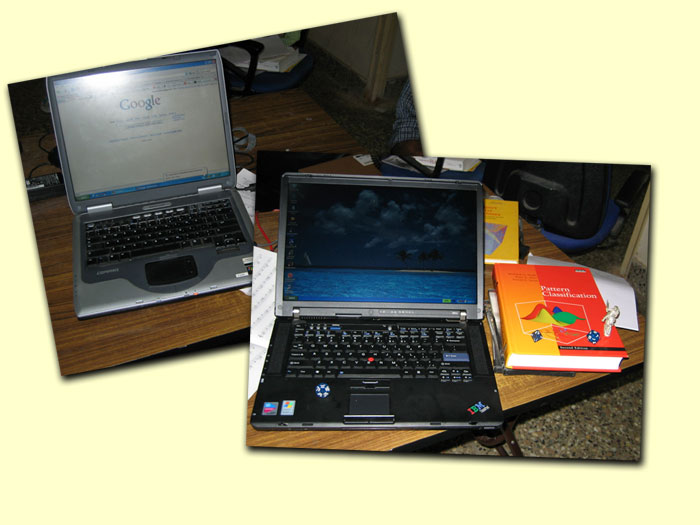 As you can see I am not too much of a photographer (the laptop screens are much duller in the photos than in real life. I have no clue why.) but the new IBM ThinkPad Z60m (on the right) is a very nice machine, much more so than the (now ancient) Compaq Presario 2100 (on the left).
Wednesday, February 01, 2006
Indians are cheap, not free!
When you are an independent consultant, you see a lot of crazy people. The most dreaded monster in this bestiary is that of the Non-Resident-Indian-Trying-To-"Develop Products"-In-Bangalore.
The game generally goes like this.
Some desperate Indian working in the USA on a regular job (note that he is NOT a venture capitalist, businessman etc) gets what he thinks is an "Awesome" idea. The he discuses this with some equally clueless friends and they hammer out some technology choices (j2ee , .net whatver). After a few weeks/months of this they decide they want the software done "cheap". Even companies which charge very little money per developer hour (say TCS) wouldn't give these folks the time of the day so they ask their friends in Bangalore to reccomend "top grade" independent developers.These poor innocents recomend people they know to be good developers and have left the corprorate rat race to work independently.
Now the fun begins. The Independent Consultant (IC from now) gets a call from the USA saying "MR X who you worked with in Company ... reccomended you as a top notch developer. We have this awesome idea that we need you to develop in "asp /.net" within 3 months. We also are looking for junior developers, testers and maybe a Project Manager. Do you think you can help us"? The consultant, if he has been independent for a while, has seen this dance many tims before and immediately asks "Do you guys have any money or is all this wishful thinking?"
There are a few different answers to this. Sometimes it is "yeah we can pay 5$ per hour for the first 24 weeks " ( I am NOT joking!!!). Or alternatively , "you see we are just starting out blah blah so we don't have much ready cash but we have all these highflying VCs lined up and if you can work free for the first 6 months then you have millions of dollars in equity".
Duh . Yeah Right.
Some of the more ... emmm .. subtle folks wants the IC to work for them without knowing what the "cool idea " is. After all a "cool idea" is very valuable right? We once encountered an "idea man" who offered to join our company as a "Project Manager" ("since it has been a long time since I coded anything") while looking for funding and in the meanwhile he would let us pay him an "industry standard" salary.
Stupidity is the one thing which REALLY has no limts.
Monday, January 30, 2006
To Teach is To Learn Twice ... And More
I am sometimes asked by clients to implement Artificial Intelligence based solutions to problems involving massive datasets, real time requirements etc. A non trivial part of this work is to transfer the knowledge of AI algorithms and the underlying maths to the client's programmers. After doing this a few times, I now have a clearer idea of some of the difficulties involved and some partial solutions for them.
- Problem 1 : Transferring Mathematical Intuition Using AI effectively often demands a deep understanding of the mathematics underlying whatever AI 'paradigm'/algorithm you use. For e.g. to even think about whether Neural Networks are a good solution for a problem, one needs to understand Linear Algebra at very intuitive level. To many people maths == a set of equations or symbols to be manipulated. And this manipulation and re arrangement of concepts to achieve precise effects is something programmers are naturally good at and so this tendency is even more deeply rooted in good programmers. For e.g., a lot of us have learned the equation F = m * a , where 'F' is Force, 'm' is mass and 'a' is acceleration. And to get through our exams we treat this as some kind of pluggable system in which two quantities are known (or can be derived from the given data) and the third has to be derived. This looks fairly simple. To check whether you understand the reality underlying the equation ask yourself this - "Does Force cause acceleration? Or Vice versa? Or both? Why? When?". The use of equations to *calculate* a quantity is different from being able to think effectively in terms of the concepts underlying the equation. To use mathematics effectively one has to constantly translate between the world of mathematics and the domain of the problem. Very few people(including mathematicians) feel the need to acquire this skill. People who use mathematics to get work done (e.g. Physicists/ Astronomers/ Race Car Designers) acquire this skill out of sheer necessity. Forcing oneself to translate (and asking students to translate) back and forth between English(without using mathemetical terms) and Mathematics is a valuable exercise. (try doing this for a simple differential equation and you will see what i mean) Thus, it isn't possible for someone to grab a few equations out of the latest AI/Pattern Recognition/Robotics etc book and apply them straight away to solve real world problems. To even know what is possible takes an understanding of the mathematical undepinnings of the various "families" of AI algorithms and this intuition takes a long time(at least for folks like me) to acquire. If programmers are just shown some algorithms or mathematical proofs, it is very unlikely they will be able to program an effective system or even maintain a system to meet changing environments. This is complicated by the fact that intuition may take a few years to acquire but has to be transferred in a week or less. While there is no perfect solution to this, I find that one can transfer large "chunks" of intuition through carefully selected (sequences of) motivating examples. In my first "iteration" of teaching, I said (in effect), "o.k. here is the (basic) theory. This is the algorithm in pseudocode. Use this and you will get the results you want". Everyone seemed happy but the whole effort "thrashed " for quite a while before delivering the (astoundingly effective) results. So these days, I try to instill an understanding of the theory distinct from the programming effort. More of a "teach how to fish" while giving the student enough "fish" so he doesn't starve till he learns to fend for himself. Thus instead of just throwing out the algorithms for (say) prediction and monitoring of data streams using Markov models, I start with real world examples of prediction vs monitoring and slowly feed in the maths (equations first, trivial programs next, then proofs, then real world programs). Given sharp "students" (as most of the programmers I interact with on a daily basis are, (Thank God!)) this works suprisingly well. I sometimes feel I am spinning a rope bridge across yawning chasms but the notion of a "slice" through a system works just as well in mathematics as in agile "story card" based implementation. Once a few cables are thrown across, programmers feel brave enough to explore the abyss a few feet at a time without too much assistance.
- Problem 2 : Getting beyond "right" and "wrong" Sometimes in spite of my best attempts at simplifying and communicating, my "students" (I think of them as peer programmers rather than as students, hence the quote marks) sometimes misunderstand and "screw up" the concepts and write strange programs or advance baffling arguments. In the beginning my response was "That is NOT what I said! THIS is what you need to do. PLEASE look at the examples/notes/code. Aaaargh!!!! Not Again! ". A more effective way is to try to figure out what the student's mental model is, faulty though it be. So now, instead of reacting to a totally off track argument by (mentally) banging my head on the nearest wall, I say to myself "What he says makes sense to him. So what mental/model thought processes has he adopted which causes him to see the world in a fashion that makes this argument logical?". The moment I can identify this precisely I am able to come up with an illuminating example that demonstrates the error. And sometimes it turns out they are on to something important and it is my perceptions that need fixing. "Learn Twice" indeed.
- Problem 3 : Ability to Do != Ability to Teach Sometimes the "teaching" gets so fatigue-inducing that I think to myself "I could have coded up all this in one tenth the time it taks me to communicate to someone else". My client, (being wiser than I) insisted on the teaching approach. What I have realized that many people (including Yours Truly) know how to do many thngs but are not often able to explain how they do them or teach others to do likewise. When you teach others you have to know each concept in a crystal clear fashion and also grok all the inteconnections between the concepts. Teaching often involves re-arranging concepts in increasing order of complexity and interdependence, seeking real life and programming examples that illustrate each facet of a concept with great clarity and slowly transitioning into complex real world problems and solutions. After teaching others, I understand many things at a much deeper level than I used to. That being said, teaching consumes massive amounts of time. I have to work 10 hours or more to prepare for a three hour "lecture". Thus "teaching" conflicts with "doing". For the time being, I'll focus on being a programmer more than a "teacher" type but I wonder how others manage. There is a lot more I could write but this post is long enough. In another entry I will look into the difference between "Real world" and "Toy" AI.
Wednesday, January 25, 2006
Some people really get it..
from Xooglers
Sergey once asked a large assemblage of Googlers what our greatest corporate expense was. “Health insurance!” was one answer shouted back. “Salaries!” “Servers!” “Taxes!” “Electricity!” “Charlie’s grocery bills!,” came back others. “No,” said Sergey. “Opportunity cost.” He explained that the products we weren’t launching and the deals we weren’t doing threatened our economic stability more than any single line item in the budget.
How insightful is that? No wonder Google has no problems hiring good people.
Laptop Wars 3 - And the Winner is
an IBM -Lenovo Thinkpad z60m. The model I chose is a marginally less powerful (and less expensive) than the one reviewed in the article I linked to, but I have added some goodies like a hot swappable battery. I paid less than 2k $ for a jazzed up to the gills Thinkpad.
The macbook finally lost out because (a)I don't want to pay good money for beta testing apple's new hardware architecture (The G4 powerbook is too underpowered, and (soon to be) abandoned by Apple anwyay, not to mention terrible display issues on some of them which Apple pretends not to notice). (b)reliability issues with a macbook are likely to be life sucking given the atrocious customer service here in India. If I lived in the USA or Europe I may have been more tempted by the macbook.
IBM has excellent customer service in Bangalore and I have taken out a 3 year warranty. (130$ vs 340$ for the macbook). The Thinkpad outmatches the powerbook in sheer ruggedness. Hopefully in a couple of years Apple will have worked the kinks out of their new hardware choices and I will wait till then to drink the Apple Kool Aid.
My new laptop is on its way to my friend (who lives in the USA) and I should get my hands on it in early March and I will post my experiences installing Linux on the new laptop then.
Sunday, January 22, 2006
Laptop wars 2 - Macbook Pro Vs IBM Thinkpad
A brief update.
I am now thinking of buying either a MacBook Pro (if it comes out before Feb 28, the day my friend - who will bring it to Bangalore- leaves the USA) or an IBM/Lenovo Thinkpad (extremely well suited to Linux - multiple sources confirm that suspend to disk and power management work well and the Thinkpad has a reputaion for rugged construction). The Macbook will cost me about 2600$ (including taxes) and the Thinkpad should be about 1200$. The trouble with the macbook of course is that it is based on new hardware and Apple has historically had problems with new hardware with the 12 in iBook G3 having a particularly horrendous history.
In either case, I'll be buying the machine from the USA. Prices in India are insane with a surcharge of almost 25% on any model, the macbooks being particularly pricey. For that kind of price differential I could buy a 20 in cinema display in addition to the macbook. Anyone returning from the USA can bring in a laptop with no customs duty thus making it cheaper by about 25-30%. Duh! Am I the only one who thinks that is a particularly stupid way to run an economy? And India is going to be the 21 st century SuperPower? Yeah Right!
Saturday, January 14, 2006
The Agile Religion and the need for Merciless Pragmatism
Does anyone else get the feeling that "Agile" is now a religion with its holy books, many patriarchs, its churches, and commandments? ("Thou shalt work in pairs"). It is just a set of useful practices, master them, adapt them, use what works, discard the rest and get on with life.
The moment 'agile' becomes some kind of religion with itinerant preachers of the Holy Word attempting to convert the unwashed heathen to the worship of the True God, its time to step back and take a hard look at what is being attempted. Kent Beck made a list of practices which he found useful. Later a whole bunch of marketing was thrown at it and we have the present situation where people speak of "true agile" , "distributed agile" "xp 2nd edition vs xp 1st edition" and so on.
Another factor often ignore is that most of the "agile" methodologies (to use the word loosely) have their origins in the world of enterprise programming where teams of programmers wrestle with coding up systems for banks, insurance companies etc. Thus there are a lot of assumptions built into the extreme programming and other agile methods which simply don't hold in other contexts.
As a simple example, think about "Customer" and "onsite customer" in the context of a massive open source effort like the Linux Kernel. These terms just don't make sense. Any efforts to twist the meaning of the word to mean "the community" etc just robs the word of any meaning.
There is an even deeper notion of the separation of "what to program" (the customer) from "how to program" (the coder).A "luminary" who spoke on Agile recently said "Programming is all about taking knowledge from others and converting it to code". (Really! I am NOT making this up!)
"Take knowledge from others". Bzzzt! Cluelessness Alert! This may be true in the practice of consulting/business app/enterprise programming etc today but not necessarily elsewhere (Kernel hacking, scientific programming, compilers, embdded programming etc)
I think this view of the programmer as some kind of "coding body" with the "domain knowledge" residing elsewhere is deeply embedded into many "schools" of "agile". More about this in another blog entry but this separation of "what" and "how" has many built in assumptions about the context in which programming occurs.
There are whole worlds of programming outside the "enterprise" world where the 'agile practices' apply very tenuously, if at all.
And even within the enterprise programming domain, agile /xp/ whatever-the-latest-buzzword should be constantly (re) evaluated, adapted and modified, not adopted and propogated mindlessly (I have been guilty of such behaviour in the past and use this blog post to unreservedly apologize to my victims).
If I want some kind of religious experience I can go to my nearest Descent-Of-The-Holy-Spirit-Scream-and-Yell-And-Speak-In-Tongues- Church. When I go to work I want logic, pragmatism and rationality.
I have adopted the "constantly growing test suite","refactoring" and "continous integration" ideas from XP to my work and jettsioned the rest. It is simply impossible to "pair program", do "test driven design" etc in the context in which I work.
TDD is, in retrospect, an insane approach to design. But more about that in another blog entry.
To conclude, the "agile" schools of programming do have many useful ideas. But "agile" is neither a scientific theory (like Relativity) nor some kind of Divine Revelation. They are just a list of practices which work(ed) for some people in some contexts. Beware of "Agile Consultants", "Agile Enablers", etc. Lock that chequebook away and do some focussed thinking and experimenting. Pragmatism trumps religious fervor any day.
Tuesday, January 10, 2006
PowerBook Vs Linux Laptop
I have always wanted a powerbook. And with some "out of band" money coming in from a consulting assignment, I was planning to buy one.
I actually wanted to buy one pronto and if I were not waiting for Steve Jobs's address tomorrow, I would probably have bought one.
After I got home I was reading some reviews of the PowerBook and came across this.
WTF?
I have to pay Apple a premium price so they can dump bad hardware on me? My Compaq Presario 2100 has been treated very roughly over the last 3 years and still works without a hitch.
I am now inclined towards getting a good Linux laptop and am now waiting for my friend (and Kernel Hacker) Mridul Jain to reccomend a good laptop for Linux. I particularly require hibernate (to disk not to RAM) to work well and flawless power management.
Later in the day I'll investigate the display problems in detail. I am hearing more and more horror stories about Apple's machines which makes me very leery of buying them in a country with terrible consumer protection laws.
Update : the PowrBook is definitely out of the picture. Linux forever!
Sunday, January 08, 2006
Startup !
It is official. My friend Rajesh and I just shook (virtual) hands over an interstate phone connection on an agreement to create a startup company.
Right now there is just the intent to create a startup. We were talking of various ideas and suddenly it was "Hey why don't we start a company and do this instead of talking about it?--Yeah ! makes sense! Let's do it. Pick a day to launch--How about April Fools Day?--I like it! ".
So don't ask "What are you building? " (I wouldn't tell you anyway :-)). We have, as always, many ideas being kicked around and both of us are quite ...errr... unstable in different ways so what we are doing will probably get nailed down hours before the launch of the company (slated for Aril 1, 2006 ,the Paperwork Gods consenting). I would expect that there will be a stealth mode for quite some time after the official launch. I have quite a bit of stuff to wind down before April.
I am looking forward to this. The dynamics of a Jedi/Sith alliance promises to be interesting. Our strengths and personalities are very complementary.
Oh yeah. I am finally getting that 17" PowerBook as well :-).
This is going to be fun.
Friday, January 06, 2006
What is your company's M/E ratio?
In simpler words, how many managers do you have per engineer? Look around you . Count the number of managers in your floor/division/office. Count the number of people who actually write or test code. Divide the former by the latter. That is your M/E ratio.
Now reflect on this snippet from this very interesting essay
"...For instance, you can do what Google does, and give each manager 200 direct reports, rather than the classic 7 or 8, so your management overhead grows with the log base-200 of the number of engineers, rather than the log base-8. That's the kind of clever thinking that comes from hiring math-y Ph.D.s, you know..."
As a thought experiment, imagine that your organization hired brilliant engineers and every manager had 200 of them reporting to him and that your CEO, CTO , and the seniormost people in the organization were all PhDs or well known hackers. What do you think might happen? I believe most "don't rock the boat and get my huge salary for pushing paper" type managers would flee in horror. With 200 reports, they won't have the time to harass people and act like the Dilbertian PHB. They might , you know, really add some value! I think you will end up getting really good managers (no, "good manager" is NOT an oxymoron. They are rare but they do exist).
And more importantly with log-base-200 growth rate, the empire building politics playing manger will be relentlessly squeezed out.
In the last company I worked at, this ratio was about 1/8. Would have been much better, in retrospect, to have had an M/E ratio of about 1/20 (at least). Something to keep in mind if I ever get to create a multi billion dollar company.
I think the biggest favor Google has done the world is to prove that an engineer centric, low manager count, ignore-wall-street-and-please-the-customers company can make a lot of money. So no matter what their eventual fate, you can be sure a new generation of entrepreneurs will be paying attention. And learning.
Thursday, January 05, 2006
Monads And Causality
Geenerally I don't post "just links" on my blog. But this time I'll make an exception, because these are very lucid explanations to difficult questions.
Question 1 : How do I explain Monads to a programmer without resorting to mathematics (Category Theory)? (This in turn came out of an email exchange with Peter Van Roy about explicit state vs monadic state (as used in Haskell))
The answer is here.
This is the best answer I've ever seen which skirts Category Theory and various Haskellisms completely.
Question 2 : How can you really know if one factor causes another? (This came out of a conversation I had with a programmer working on a probabilistic classifer [I am working with them on integrating Machine Learning into their product suite])
Here are two sets of slides explaining the approach pioneered by Dr Judea Pearl at UCLA. To oversimplify, a new operator is added to probability theory with a separate semantics. This is a bit beyond standard probability but quite enlightening once you "get it".
On admitting what you got wrong
from Jeffrey Shallit's blog.
....Blondlot's tale is a cautionary one. By contrast, I offer a case where the proper behavior was displayed, from Richard Dawkins' 1996 Richard Dimbleby lecture:
A formative influence on my undergraduate self was the response of a respected elder statesmen of the Oxford Zoology Department when an American visitor had just publicly disproved his favourite theory. The old man strode to the front of the lecture hall, shook the American warmly by the hand and declared in ringing, emotional tones: "My dear fellow, I wish to thank you. I have been wrong these fifteen years." And we clapped our hands red.
Admitting you are wrong is a basic part of the mathematical and scientific ethic. ...
I think it ought to be part of one's personal ethic too.
So here is a (tongue firmly attached to cheek) list of what I was wrong about. Be warned, this is a jumbled list of "lessons learned" and is intrinsically very subjective. Don't expect any coherence.
- Ruby has a perl flavor.
- Ruby is way better than Java.
- A software developer in Bangalore can't do innovative, interesting work and make good money.
- Developing Enterprise Software, especially "outsourced" software is a worthwhile career.
- A knowledge of Mathematics/Programming Language Theory -insert other 'deep' subject here- is unnecessary to build good software.
- Mathematics is boring
- There is plenty of time to find out what to do in life and there is plenty of time to do it.
- Objects are the best way to design programs.
- Programmers are logical people and not prone to delusions and religious mania.
- Agile Methodologies will work (better than what they are already doing) for most teams/products.
- Most managers have a clue about their work/organizations/what their jobs are all about.
- It is impossible to make massive amounts of money doing nothing/ by making other people miserable/delivering negative value (see above).
- All managers are technically clueless.
- In practice, Management, specially in the offshored software world, really adds value and is not a big con game.
- It is impossible to combine being a manager (to get those massive salaries while doing nothing important) and a techie (to retain a of self worth and give life meaning).
- Dilbert is fiction.
- One person can't change the world
- You have to be extra ordinarily talented to change the world.
- The software industry is immune to political correctness fads because it is populated by logical, edcucated people (witness the noise around "diversity" or "we need more women in software")
- Engineers can't master business and are bad at "reading the market", "understanding business value" etc and need support in the form of analysts/managers.
- Some behaviours are so morally dubious that people who indulge in them exist only in fiction . Even if such people exist in the real world, they are very rare and you won't encounter them.
- If you know a person well, you can predict what he or she will or will not do.
- Talented people have a greater probability of being morally upright.
- In real life the good guys don't always win.
- Believing in God is better than being an atheist/agnostic.
- Being an atheist/agnostic is better than being a believer.
Saturday, December 31, 2005
The perils of Java companies
Joel Spolsky writes on the perils of Java schools.Read it. It is an excellent article.
Now dwell on the fact that many of the same conclusions could apply to you if you have never developed a piece of software in a language other than Java or C#. Have you ever created a 5000 line + program in a language other than Java/C#? Do you know (as in wrote some decent programs in) any paradigms other than OO? Do you really know OO? (If you've learned only Java you probably don't). Do you work in a Java(C#) company?
With a new year dawning, it is a good time to make a resolution to improve your programming skills. Alternatively you could just "climb the ladder" and slump into "project management" or "iso/cmm".
Monday, December 26, 2005
Year End Retrospective
Over the last year or so, I have worked alone. This was a nice change from being part of a "globally distributed team", attending stand up (and other) meetings, endless 'pairing' sessions, and other "agile" practices.
As the year draws to an end, I think it maybe worthwhile to explore and clarify what I learned and how I changed.
First, I am now utterly disgusted with 'off shored enterprise' coding. I was never really comfortable with the bland projects that wash ashore in this domain. Too often the projects were utterly boring, in spite of working with some of the best companies and people. The last year has been fantastic in terms of the challenge and complexity of programming and I hope I never have to work on a leasing/banking/insurance/blah database-to-web-and-back, C#-or-java, offshored-to-save-money-by-hiring-tonnes-of-cheap-coding_bodies project in my life again! So help me God!
Second, working on some extremely tough problems have taught me to tone down my enthusiasm for (a) "OO" and (b) "agile". Don't get me wrong, there is much that is valuable in both but these days I see their limits with painful clarity. Now, I see Objects as one (vs the only) way to tackle a problem and while I still follow some of the agile practices (like unit testing and Continous Integration), I am very skeptical of the value of "pairing" etc, outside the simplicities of the "enterprise app" domain.
Third, I am now very focussed on three major themes - (a)learning to create "tough" programs(kernel hacking is tough, creating a normal insurance app in j2ee is not), (b) applying "deep theory" to practical ends (applying Bayesian Classification to spam filtering vs design pattens/mock objects/what have you in a standard business app) and (c) working towards being *really* good at programming, in global terms (and not just be another cheap Indian offshore programmer, or even worse , manager).
More concretely, in the coming year I plan to deepen my knowledge of AI and Compilers and also learn to hack hardware,besides acquiring more mathematical understanding.
2006 looks glorious! Happy New Year all.
Update: Thanks to Teju's comment, I've thought about this a little more.Here is a quick checklist of questions
- Is your project interesting? Do you feel exhilarated or bored when working on your project?
- Are the people on your project there because of their expertise or are they there to increase billing? If you left the project would it be hard or easy to replace you? How unique are your skills?
- Do you learn new things every day or do you just do the same things over and over again? (this is characteristic of most offshored "enterprise" work, imo)
- If you had all the money you wanted, would you still choose to work on this project? Or would you do something else?
Saturday, December 10, 2005
What Mr Fowler Really Said
Martin Fowler's post on "Humane Interfaces" has set off a maelstrom in the 'blogosphere'. (He has referred to some of the more interesting posts in his updates to his entry).
As is typical in the world of software, the original points were soon lost in a cacophony of arbitrarily drawn battle lines (java vs ruby, open vs closed class systems, Java's List interfaces vs LinkedList class etc).
This is what I understood from Martin's post. (Heavily paraphrased. Don't blame Martin for any butchery I commit on his prose)
...There are two approaches to designing interfaces. One I (Martin) label the "Humane" approach. Another is the "minimal" approach. Here is an example..{ } .. The distinctions between these approaches are worth thinking about. I (Martin) lean toward the humane approach...
As readers of this blog know, I am all in favor of subjecting opinions to logical scrutiny. But I fail to see how this can be any clearer. It seems fairly obvious that (a) the example used is just that - one example and (b) either approach can be used in any language. Where did "Java vs Ruby" come from? What am I missing?
[rant] I am getting fairly irritated at the lack of clear thinking prevalent in the software world. Aaargh! [end rant]
Sunday, December 04, 2005
Why a Lexus is Not An Acceptable Ferrari
Eric Kidd explains on his blog why he thinks 'Ruby is an Acceptable Lisp'.
His thesis is debunked very effectively in the comments section of his blog entry. What I find fascinating is the thinking behind this position.
Let us look at how Eric tries to assert his position that Ruby is as dense (or occasionally denser) than Lisp. He first creates an example of a lisp function , then writes a ruby equivalent which is marginally shorter, while brushing off the capabilties of lisp (reader macros in this case) because "it is not commonly done"!
First , this thinking is fallacious. The fallacy is called "Biased Generalization". From the Nizkor Project,
Description of Biased Sample
This fallacy is committed when a person draws a conclusion about a population based on a sample that is biased or prejudiced in some manner. It has the following form:
- Sample S, which is biased, is taken from population P.
- Conclusion C is drawn about Population P based on S.
Thursday, December 01, 2005
Availability Update
I am not available for consulting assignments till (at least) the end of March 2006. Before writing to me to enquire about availability, do read this first.
I have just started a very interesting project which attempts to integrate machine learning into a massively successful product suite.The size of the data sets and the business requirements make this fairly challenging.
This, when added to my existing commitments (including some very interesting Open Source work), leaves me no time to take on more work till end of Q1 2006.
How Agile Dies
Bill Caputo writes
Perhaps the Agile of today -- represented by things like the Microsoft TDD article, the attempts by many consulting firms to make Agile a methodology (instead of set of principles like it used to be), and the increasing adoption of "Agile" by big IT -- deserves this criticism, but the Agile movement I remember held their observation as a premise.
*That* agile movement seems to already be dying out, but its echoes might still carry the message (if not recognize the messengers) When you see people offering to "enable" half wit teams for outrageous amounts of money, and "agile" becomes another merketdroid buzzword on the same level as 'ISO 9000 certified' or 'CMM Level 5', you know you'd better call for a priest to administer the last rites. Many companies in Bangalore are eagerly "developing an agile practice", which (but of course!) goes hand in hand with ISO 9000/CMM Level X /Whatever other BS 'methodologies' are already in place. One of my friends, who works in 'Big IT', recently responded to "So what do you do?" with "I work in Organized Crime. I am part of an international syndicate that cons businessmen out of insane amounts of money and delivers little value in return". Heh!Sunday, November 27, 2005
Tech Company Caste Systems
From Businessweek
The suits inside Google don't fare much better than the outside pros. Several current and former insiders say there's a caste system, in which business types are second-class citizens to Google's valued code jockeys. They argue that it could prove to be a big challenge in the future as Google seeks to maintain its growth. They deem the corporate development team as underpowered in the company, with engineers and product managers tending to carry more clout than salesmen and dealmakers.
So a 'caste system' in which 'business types' are second class hurts?
How about the 'caste system' in place in most companies where the suits are on top? I guess that is the 'natural order of things' ? :-)
The outlines of the 'caste system' in place in most 'India Development Centres' can be deduced by examining one expense item - tickets for international flights. Most 'business types' fly first or business class while the 'India Developer Assets' are packed into Economy Class. To see something even more interesting, examine what kind of tickets are bought for Caucasians vs Indians.
Do I mind any of this? Not really. Any game is played in a particular fashion because all players agree to play it that way.
It is upto people playing the game to make sure the rules are fair.
What bothers me is the intellectual dishonesty in the implication that "business types on top" is natural but "techs on top" is not. I would have thought that the effectiveness of any company's internal structure would be judged by how successful it is. And by that metric Google is outstandingly successful. So may be the 'new caste system' is 'valid' after all?
I wonder if anyone is working for a "casteless" company? What would such a beast look like?
Update: Slashdot has picked up the businessweek story
Thursday, November 24, 2005
I Love China!!!!
From mini-msft
"... Shanghai: the same week various posts come out discussing working with Microsoft engineers in China, also noted by Dare, I took a moment to do a deep dive understanding how things are going over there and what kind of work is getting done. Seems as though most people are very happy with the high quality, hard-work, and ability to deal with Microsoft-Redmond's capricious rearchitecture du jour coming out of China. I haven't heard much in the way of complaints at all, as compared to working with Hyderabad. Microsoft India had best watch out - you guys might get outsourced to China, lending a whole new modern usage to Shanghaied. ..."
Go China go!!!!!!
Tuesday, November 22, 2005
Conversations and Deeper Issues
Brian Marick writes about Story Cards which contain only the name of the story, thus encouraging developers to talk to the customer before writing code.
This resonates with me for two reasons.
- I have seen "agile" projects start out by writing story titles on story cards, then add "supplementary" MS Word documents, then write even more bloated documents etc, and then people start saying "but that is not in the document" ,"let us update the document" etc.
- These days, I am very leery of what I see as an artificial split between "analyst" and "developer".
DabbleDb Dazzles
DabbleDb "combines the best of group spreadsheets, custom databases, and intranet web applications into a new way to manage and share your information online". It has smalltalk(Squeak ? ) and Seaside on the backend and is simply mindblowing. Watch the dabbledb movie(warning 113 Mb .mov file) if you haven't already.
Subscribe to:
Posts (Atom)