- A language with a built in eval function allows you to transform code into a parse tree at runtime.
- To the degree that the language has a uniform/flexible syntax, this transition between code and data is painless
- All language transforms consist of two steps . First you convert a string into a data structure called a "syntax tree" . This is called parsing. Then various transformations can be done on this data structure to produce the effect you want. Thus the string "2 + 3" can be converted into a datastructure like "{ operator: "+", operand1:"2", operand2:"3"}". Then you can define various transforms that work on (or "visit" in oo terms) the components of the data structure and do whatever you want. e.g : (pseudocode) def print(anAst) puts anAst.operand1,anAst.operator,anAst.operand2 end def printReversePolish(anAst) puts anAst.operand1,anAst.operand2,anAst.operator end def evaluate(anAst) return anAst.operand1 + anAst.operand2 end anAst = parse("2 + 3") print(anAst) => 2 + 3 printReversePolish(anAst) => 2 3 + evaluate(anAST) => 5 and that is all there is (conceptually) to any langauge transform.
- Ruby "DSL" s allow people who haven't studied the fundamentals of computer science to think they are discovering something new and amazing. Yes, Ruby allows a somewhat seamless mixing of "pure" ruby and "dsl" code, but this is just as true for any langauge with a built in eval and clean syntax. (lisp, forth, even smalltalk). The built in "eval" takes care of the parsing (as long as the syntax does not vary too widely from ruby syntax)
Tuesday, April 18, 2006
Everything Old is New Again - The Ruby DSL hype
Update: I've received a few mails asking how to go about creating dsl s "the right way" in Ruby. If you are in Bangalore, I suggest you attend the Ruby DSL talk at the Agile India 2006 by my friends Badri and Sudarshan (both Thoughtworkers). Such things are best learned by demonstration than reading about it and the Badri and Sudarshan are probably the best people in Bangalore to learn from.
If you are not in Bangalore find someone who knows and ask him to teach you. :-)
[Rant]
These things have been true from the dawn of programming languages
The next time someone tries to tell you how he created this uber cool "dsl" in ruby AND that this takes some fundamentally new technique, laugh in his face.
Ok , biting your tongue and walking away quietly is almost as good.
DSLs like any other programming technique, when used appropriately gives some beneficial effects. But it is no panacea and a casual perusal of the net will reveal a bunch of atrocious dsls . Beware the hype and snake oil.
[end Rant]
Saturday, April 08, 2006
Learning from a Master{Class}
I attended a series of lectures on technical topics today and here are my "take away points" in no particular order.
- "Service Oriented Architecture" is an empty buzzword label designed to squeeze money out of unsuspecting clients
- Good ideas (e.g: "role playing" a presentation) needs to be executed flawlessly to be effective and cannot be substitute for a belief in what one is speaking about.
- Having one set of people selecting topics and another set of people being "volunteered" to speak is a terrible way of attempting to deliver a great speech/session.
- Having original insights arranged in a logical structure is key to a good speech. Presentation skills provide a final finish.
- Insight arises from taking the time to rigorously think about what is important, and by asking "why" for things everyone takes for granted.
- Here is a way to test your "hacker quotient" (assuming you are a programmer). How much of your code is written by you wanting to code it vs having to code it?
- If a series of sessions is to be arranged on a single theme, care should be taken to have them rise to a peak, in terms of quality of content and speakers. An abrubt decline in (relative) quality drives the audience away (fast).
- If you don't have a good, genuine question to ask the speaker after a speech, for God's sake, shut up and sit down. Nobody thinks you are smart if you ask vague, inchoate and stupid questions .
Wednesday, April 05, 2006
The Rest Of The Year - Plans
I just rolled off a Telecom Fraud Detection project that saw the successful deployment of one of my core foci - Artificial Intelligence. My next project in 2006 will be in my next major focus area - compilers.
I can't talk too much about this in public yet but I can say that till about August middle/September beginning (tentative deadline) I will be building a production quality compiler for some custom hardware. Large parts of this project (if not all of it) will be open sourced at the end of the project, once the code base is stable enough. Parallelly I hope to help one of my friends bring out a product, and do a serious upgrade of my mathematics skills.
Life is good.
[Context Switch]
If any readers of this blog want to meet me, the Agile India Conference, (where Rajesh and I are doing a linked pair of talks on Robotics) is a good chance to do so.
I shall be talking about language design issues in robotics and Rajesh, on the problems of implementing custom firmware . There are many other interesting sessions on the agenda ( I particularly look forward to KD's speech on the impact of Culture on Agile Practices - knowing KD, this promises to be a real blast), so if you are in Bangalore (or can get to Bangalore, don't miss the fun. (Registration will open later tonight).
Update : Registration for Agile India 2006 is now open.
Friday, March 31, 2006
The Storm Before the Calm
As of May the 6th of 2006 (the final day of the Agile India Conference, where I am speaking on "The Design And Implementation of Robotics Languages"), I am completely abandoning all connections to the "offshored software" world. No more agile/extremeprogrammng/tdd, no more j2ee, no more "offshore teams" delivering "superior business value" using "best practices" crap.
Paul Graham said,
"If it is possible to make yourself into a great hacker, the way to do it may be to make the following deal with yourself: you never have to work on boring projects (unless your family will starve otherwise), and in return, you'll never allow yourself to do a half-assed job. All the great hackers I know seem to have made that deal, though perhaps none of them had any choice in the matter."
Now whether I am or will ever be a "great hacker" aside, "you'll never work on boring projects, and in return, you'll never allow yourself to do a half-assed job." seems a fantastic principle to live by (it helps that I don't have a family I need to keep above the starvation line - Oh the blessed joys of bachelorhood :-) ).
Once you cross the age of 30, you are in the second half of your life. It is horrible enough that I spent one decade caught up in the "offshored software" paradigm. One decade - think of it and weep. A decade of dedicated practice would make you world class in anything you choose. One could be a world class athlete, musician, martial artist, dancer,writer, film maker... whatever! And I spent it writing "plonk this data off a database and put it on a set of dinky webpages" systems.
Shakespeare got it right when he made Macbeth say "And all our yesterdays have lighted fools,
The way to dusty death."
And it is a very seductive bargain - in the beginning - money for nothing, multiple trips abroad (ignoring the fact that you are roughly in the position of a Sepoy in the Old army of the British Raj, occasionally sent abroad to shed your blood in the Empire's mysterious wars), all the trappings of a "successful" life. Time blurs and you wake up to find yourself either a second grade "project manager" type implementing commands from across the seas (and trying desperately to convince yourself that you are now in a superior position compared to the lowly blue collar techies, having forgotten what little you knew) or yet another burned out "techie" having no skills beyond "j2ee" or "perl and php".
Spending any more time in that world would mean I am frittering away what remains of my life. The Red Pill came just in time, methinks.
The number of genuinely good programmers and the amount of true innovation in India is astoundingly low, for all the talk of being the "21st century superpower". The "pseudo geek" profile many people unwittingly take on is very low on substance and very high on deception.
But it is not all doom and gloom. The less something exists, the more the opportunity to create it.
The mistake,I've found, is in thinking, like many Non Resident Indians do, that "I'll go home next year (and meanwhile, endure another year of meaninglessness)". Of course "next year" never comes. If one plans to "go home", the time to do it is right now.
From Snow Crash,
" Until a man is twenty-five, he still thinks, every so often, that under the right circumstances he could be the baddest motherfucker in the world. If I moved to a martial-arts monastery in China and studied real hard for ten years. If my family was wiped out by Colombian drug dealers and I swore myself to revenge. If I got a fatal disease, had one year to live, and devoted it to wiping out street crime. If I just dropped out and devoted my life to being bad."
I am way past 25, but "devoting my life to being bad" sounds good anyway.
Saturday, February 25, 2006
The Importance of Having Friends Who Disagree
Paul Graham says, in one of his essays (emphasis mine)
"....Why do you need other people? Can't you just think of new ideas yourself? The empirical answer is: no. Even Einstein needed people to bounce ideas off. Ideas get developed in the process of explaining them to the right kind of person. You need that resistance, just as a carver needs the resistance of the wood.
This is one reason Y Combinator has a rule against investing in startups with only one founder. Practically every successful company has at least two. And because startup founders work under great pressure, it's critical they be friends....."
In my experience, this need for "friendly resistance" extends to far more than creating startups. Every time you have a new idea, you need people you can bounce it off. To get any real benefit out of this process you need people with a complex combination of characteristics.
They should
- have firm (but not rigid) opinions on their own
- have logical reasons for those beliefs and be able to articulate them clearly
- are driven by ideas and not ideology
- not attach their egos to their opinions.
- be willing to concede a valid argument even if it forces them to possibly re-examine their beliefs
- know how to listen
Tuesday, February 21, 2006
Yet Another Math Milestone
A few days ago, I discovered an error in the mathematics of a paper (on neural network optimization) being prepared for publication by a very eminent scientist. My drawing attention to this discrepancy in the proof has led to a total recasting of the approach to the problem and I will be now listed as a co-author of the paper.
Hmm yeah. Whatever. So how is this significant?
Well this is the first time I have used my skill in mathematics (vs my skill in programming) to contribute significantly to a scientific effort. In an old blog post I had theorised that the acquisition of "mathematical thinking" would follow a four step path. I said ..
- the first step in mastering math is be to learn to read the notation. just like learning the syntax of a new programming language
- the second is to grasp the reality expressed by the notation at a gut level , like understanding the paradigm and patterns lying underneath a programming language , like ,say ,beginning to grok "oo"
- the third is to use that understanding to create new possibilities
- the fourth is to use a programming language to embody and refine those possibilities , thus creating programs that do what has never been done before.
Saturday, February 11, 2006
Wir sind alle Dänen
This is the rare "political" post. Those not interested, move right on.
Enough is enough.
In my opinion it is foolishness to initiate a "clash of civilizations". But if there is a battle line forming by virtue of some people insisting that their religious laws should apply to people of other religions (or no religion) then I know on which side I stand.
Anyone has the right to be "offended". That does not give them the right to kill, burn and issue threats. Fwiw, I do not believe in Islam, Mohammed, his "sacredness" or infallibility, etc etc. The people who protest most at this "disrespect" have laws in their own countries that officially forbid the practice of any other religion. If you carry a Bible or Bhagavad Gita into Saudi Arabia, it will be seized and shredded at the airport. How dare they protest against any "disrespect"? First practice this "respect to other religions" and then complain your religion isn't respected.
Kennedy once said "Two thousand years ago the proudest boast was civis Romanus sum. Today, in the world of freedom, the proudest boast is 'Ich bin ein Berliner.' All free men, wherever they may live, are citizens of Berlin, and, therefore, as a free man, I take pride in the words 'Ich bin ein Berliner!'"
Today, all free men, no matter where they live, are citizens of Denmark.
Wir sind alle Dänen.
Update: This post has generated a lot of feedback mostly by email (some people seem afraid to express themselves in public. hmmm...) .
One comment on this blog (subsequently deleted by the author) said "There's also the trap of 'they don't respect my religion/beliefs/whatnot so why should I respect theirs?'. That's the point where civilized conversation breaks down." .
This is a little naive. You can't have a conversation with people who don't follow the norms of "civilized" conversation and are not interested in a conversation. This most often happens with people who are convinced that their truth (religion/prophet/Holy Book/ideology/ whatever) is infallible. There should be no tolerance of the intolerant.
From an article by the editor of Jyllands-Posten (the Danish newspaper that published the cartoons) (emphasis mine)
"Has Jyllands-Posten insulted and disrespected Islam? It certainly didn't intend to. But what does respect mean? When I visit a mosque, I show my respect by taking off my shoes. I follow the customs, just as I do in a church, synagogue or other holy place. But if a believer demands that I, as a nonbeliever, observe his taboos in the public domain, he is not asking for my respect, but for my submission. And that is incompatible with a secular democracy."
So yes, this kaffir maintains that anyone who demands rights and respect that he is not willing to give to others is a hypocrite.
And while I may not (or may) be impressed with Islam or its Prophet, (that is my privilege in a free society), my stance is not anti-Islam but anti-hypocrisy.
People (of any religion) who say "respect my religion" should extend respect to other religions (and to atheists). There is no one way "civilized debate".
Saturday, February 04, 2006
Old Laptop, Meet New Laptop
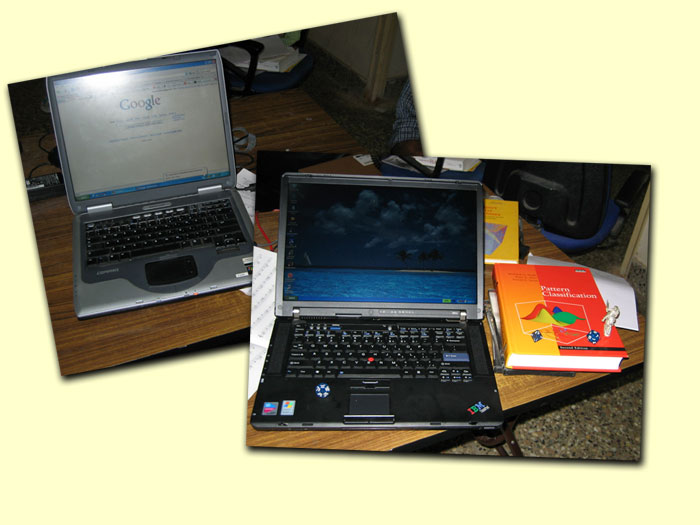 As you can see I am not too much of a photographer (the laptop screens are much duller in the photos than in real life. I have no clue why.) but the new IBM ThinkPad Z60m (on the right) is a very nice machine, much more so than the (now ancient) Compaq Presario 2100 (on the left).
Wednesday, February 01, 2006
Indians are cheap, not free!
When you are an independent consultant, you see a lot of crazy people. The most dreaded monster in this bestiary is that of the Non-Resident-Indian-Trying-To-"Develop Products"-In-Bangalore.
The game generally goes like this.
Some desperate Indian working in the USA on a regular job (note that he is NOT a venture capitalist, businessman etc) gets what he thinks is an "Awesome" idea. The he discuses this with some equally clueless friends and they hammer out some technology choices (j2ee , .net whatver). After a few weeks/months of this they decide they want the software done "cheap". Even companies which charge very little money per developer hour (say TCS) wouldn't give these folks the time of the day so they ask their friends in Bangalore to reccomend "top grade" independent developers.These poor innocents recomend people they know to be good developers and have left the corprorate rat race to work independently.
Now the fun begins. The Independent Consultant (IC from now) gets a call from the USA saying "MR X who you worked with in Company ... reccomended you as a top notch developer. We have this awesome idea that we need you to develop in "asp /.net" within 3 months. We also are looking for junior developers, testers and maybe a Project Manager. Do you think you can help us"? The consultant, if he has been independent for a while, has seen this dance many tims before and immediately asks "Do you guys have any money or is all this wishful thinking?"
There are a few different answers to this. Sometimes it is "yeah we can pay 5$ per hour for the first 24 weeks " ( I am NOT joking!!!). Or alternatively , "you see we are just starting out blah blah so we don't have much ready cash but we have all these highflying VCs lined up and if you can work free for the first 6 months then you have millions of dollars in equity".
Duh . Yeah Right.
Some of the more ... emmm .. subtle folks wants the IC to work for them without knowing what the "cool idea " is. After all a "cool idea" is very valuable right? We once encountered an "idea man" who offered to join our company as a "Project Manager" ("since it has been a long time since I coded anything") while looking for funding and in the meanwhile he would let us pay him an "industry standard" salary.
Stupidity is the one thing which REALLY has no limts.
Monday, January 30, 2006
To Teach is To Learn Twice ... And More
I am sometimes asked by clients to implement Artificial Intelligence based solutions to problems involving massive datasets, real time requirements etc. A non trivial part of this work is to transfer the knowledge of AI algorithms and the underlying maths to the client's programmers. After doing this a few times, I now have a clearer idea of some of the difficulties involved and some partial solutions for them.
- Problem 1 : Transferring Mathematical Intuition Using AI effectively often demands a deep understanding of the mathematics underlying whatever AI 'paradigm'/algorithm you use. For e.g. to even think about whether Neural Networks are a good solution for a problem, one needs to understand Linear Algebra at very intuitive level. To many people maths == a set of equations or symbols to be manipulated. And this manipulation and re arrangement of concepts to achieve precise effects is something programmers are naturally good at and so this tendency is even more deeply rooted in good programmers. For e.g., a lot of us have learned the equation F = m * a , where 'F' is Force, 'm' is mass and 'a' is acceleration. And to get through our exams we treat this as some kind of pluggable system in which two quantities are known (or can be derived from the given data) and the third has to be derived. This looks fairly simple. To check whether you understand the reality underlying the equation ask yourself this - "Does Force cause acceleration? Or Vice versa? Or both? Why? When?". The use of equations to *calculate* a quantity is different from being able to think effectively in terms of the concepts underlying the equation. To use mathematics effectively one has to constantly translate between the world of mathematics and the domain of the problem. Very few people(including mathematicians) feel the need to acquire this skill. People who use mathematics to get work done (e.g. Physicists/ Astronomers/ Race Car Designers) acquire this skill out of sheer necessity. Forcing oneself to translate (and asking students to translate) back and forth between English(without using mathemetical terms) and Mathematics is a valuable exercise. (try doing this for a simple differential equation and you will see what i mean) Thus, it isn't possible for someone to grab a few equations out of the latest AI/Pattern Recognition/Robotics etc book and apply them straight away to solve real world problems. To even know what is possible takes an understanding of the mathematical undepinnings of the various "families" of AI algorithms and this intuition takes a long time(at least for folks like me) to acquire. If programmers are just shown some algorithms or mathematical proofs, it is very unlikely they will be able to program an effective system or even maintain a system to meet changing environments. This is complicated by the fact that intuition may take a few years to acquire but has to be transferred in a week or less. While there is no perfect solution to this, I find that one can transfer large "chunks" of intuition through carefully selected (sequences of) motivating examples. In my first "iteration" of teaching, I said (in effect), "o.k. here is the (basic) theory. This is the algorithm in pseudocode. Use this and you will get the results you want". Everyone seemed happy but the whole effort "thrashed " for quite a while before delivering the (astoundingly effective) results. So these days, I try to instill an understanding of the theory distinct from the programming effort. More of a "teach how to fish" while giving the student enough "fish" so he doesn't starve till he learns to fend for himself. Thus instead of just throwing out the algorithms for (say) prediction and monitoring of data streams using Markov models, I start with real world examples of prediction vs monitoring and slowly feed in the maths (equations first, trivial programs next, then proofs, then real world programs). Given sharp "students" (as most of the programmers I interact with on a daily basis are, (Thank God!)) this works suprisingly well. I sometimes feel I am spinning a rope bridge across yawning chasms but the notion of a "slice" through a system works just as well in mathematics as in agile "story card" based implementation. Once a few cables are thrown across, programmers feel brave enough to explore the abyss a few feet at a time without too much assistance.
- Problem 2 : Getting beyond "right" and "wrong" Sometimes in spite of my best attempts at simplifying and communicating, my "students" (I think of them as peer programmers rather than as students, hence the quote marks) sometimes misunderstand and "screw up" the concepts and write strange programs or advance baffling arguments. In the beginning my response was "That is NOT what I said! THIS is what you need to do. PLEASE look at the examples/notes/code. Aaaargh!!!! Not Again! ". A more effective way is to try to figure out what the student's mental model is, faulty though it be. So now, instead of reacting to a totally off track argument by (mentally) banging my head on the nearest wall, I say to myself "What he says makes sense to him. So what mental/model thought processes has he adopted which causes him to see the world in a fashion that makes this argument logical?". The moment I can identify this precisely I am able to come up with an illuminating example that demonstrates the error. And sometimes it turns out they are on to something important and it is my perceptions that need fixing. "Learn Twice" indeed.
- Problem 3 : Ability to Do != Ability to Teach Sometimes the "teaching" gets so fatigue-inducing that I think to myself "I could have coded up all this in one tenth the time it taks me to communicate to someone else". My client, (being wiser than I) insisted on the teaching approach. What I have realized that many people (including Yours Truly) know how to do many thngs but are not often able to explain how they do them or teach others to do likewise. When you teach others you have to know each concept in a crystal clear fashion and also grok all the inteconnections between the concepts. Teaching often involves re-arranging concepts in increasing order of complexity and interdependence, seeking real life and programming examples that illustrate each facet of a concept with great clarity and slowly transitioning into complex real world problems and solutions. After teaching others, I understand many things at a much deeper level than I used to. That being said, teaching consumes massive amounts of time. I have to work 10 hours or more to prepare for a three hour "lecture". Thus "teaching" conflicts with "doing". For the time being, I'll focus on being a programmer more than a "teacher" type but I wonder how others manage. There is a lot more I could write but this post is long enough. In another entry I will look into the difference between "Real world" and "Toy" AI.
Wednesday, January 25, 2006
Some people really get it..
from Xooglers
Sergey once asked a large assemblage of Googlers what our greatest corporate expense was. “Health insurance!” was one answer shouted back. “Salaries!” “Servers!” “Taxes!” “Electricity!” “Charlie’s grocery bills!,” came back others. “No,” said Sergey. “Opportunity cost.” He explained that the products we weren’t launching and the deals we weren’t doing threatened our economic stability more than any single line item in the budget.
How insightful is that? No wonder Google has no problems hiring good people.

Laptop Wars 3 - And the Winner is
an IBM -Lenovo Thinkpad z60m. The model I chose is a marginally less powerful (and less expensive) than the one reviewed in the article I linked to, but I have added some goodies like a hot swappable battery. I paid less than 2k $ for a jazzed up to the gills Thinkpad.
The macbook finally lost out because (a)I don't want to pay good money for beta testing apple's new hardware architecture (The G4 powerbook is too underpowered, and (soon to be) abandoned by Apple anwyay, not to mention terrible display issues on some of them which Apple pretends not to notice). (b)reliability issues with a macbook are likely to be life sucking given the atrocious customer service here in India. If I lived in the USA or Europe I may have been more tempted by the macbook.
IBM has excellent customer service in Bangalore and I have taken out a 3 year warranty. (130$ vs 340$ for the macbook). The Thinkpad outmatches the powerbook in sheer ruggedness. Hopefully in a couple of years Apple will have worked the kinks out of their new hardware choices and I will wait till then to drink the Apple Kool Aid.
My new laptop is on its way to my friend (who lives in the USA) and I should get my hands on it in early March and I will post my experiences installing Linux on the new laptop then.
Sunday, January 22, 2006
Laptop wars 2 - Macbook Pro Vs IBM Thinkpad
A brief update.
I am now thinking of buying either a MacBook Pro (if it comes out before Feb 28, the day my friend - who will bring it to Bangalore- leaves the USA) or an IBM/Lenovo Thinkpad (extremely well suited to Linux - multiple sources confirm that suspend to disk and power management work well and the Thinkpad has a reputaion for rugged construction). The Macbook will cost me about 2600$ (including taxes) and the Thinkpad should be about 1200$. The trouble with the macbook of course is that it is based on new hardware and Apple has historically had problems with new hardware with the 12 in iBook G3 having a particularly horrendous history.
In either case, I'll be buying the machine from the USA. Prices in India are insane with a surcharge of almost 25% on any model, the macbooks being particularly pricey. For that kind of price differential I could buy a 20 in cinema display in addition to the macbook. Anyone returning from the USA can bring in a laptop with no customs duty thus making it cheaper by about 25-30%. Duh! Am I the only one who thinks that is a particularly stupid way to run an economy? And India is going to be the 21 st century SuperPower? Yeah Right!
Saturday, January 14, 2006
The Agile Religion and the need for Merciless Pragmatism
Does anyone else get the feeling that "Agile" is now a religion with its holy books, many patriarchs, its churches, and commandments? ("Thou shalt work in pairs"). It is just a set of useful practices, master them, adapt them, use what works, discard the rest and get on with life.
The moment 'agile' becomes some kind of religion with itinerant preachers of the Holy Word attempting to convert the unwashed heathen to the worship of the True God, its time to step back and take a hard look at what is being attempted. Kent Beck made a list of practices which he found useful. Later a whole bunch of marketing was thrown at it and we have the present situation where people speak of "true agile" , "distributed agile" "xp 2nd edition vs xp 1st edition" and so on.
Another factor often ignore is that most of the "agile" methodologies (to use the word loosely) have their origins in the world of enterprise programming where teams of programmers wrestle with coding up systems for banks, insurance companies etc. Thus there are a lot of assumptions built into the extreme programming and other agile methods which simply don't hold in other contexts.
As a simple example, think about "Customer" and "onsite customer" in the context of a massive open source effort like the Linux Kernel. These terms just don't make sense. Any efforts to twist the meaning of the word to mean "the community" etc just robs the word of any meaning.
There is an even deeper notion of the separation of "what to program" (the customer) from "how to program" (the coder).A "luminary" who spoke on Agile recently said "Programming is all about taking knowledge from others and converting it to code". (Really! I am NOT making this up!)
"Take knowledge from others". Bzzzt! Cluelessness Alert! This may be true in the practice of consulting/business app/enterprise programming etc today but not necessarily elsewhere (Kernel hacking, scientific programming, compilers, embdded programming etc)
I think this view of the programmer as some kind of "coding body" with the "domain knowledge" residing elsewhere is deeply embedded into many "schools" of "agile". More about this in another blog entry but this separation of "what" and "how" has many built in assumptions about the context in which programming occurs.
There are whole worlds of programming outside the "enterprise" world where the 'agile practices' apply very tenuously, if at all.
And even within the enterprise programming domain, agile /xp/ whatever-the-latest-buzzword should be constantly (re) evaluated, adapted and modified, not adopted and propogated mindlessly (I have been guilty of such behaviour in the past and use this blog post to unreservedly apologize to my victims).
If I want some kind of religious experience I can go to my nearest Descent-Of-The-Holy-Spirit-Scream-and-Yell-And-Speak-In-Tongues- Church. When I go to work I want logic, pragmatism and rationality.
I have adopted the "constantly growing test suite","refactoring" and "continous integration" ideas from XP to my work and jettsioned the rest. It is simply impossible to "pair program", do "test driven design" etc in the context in which I work.
TDD is, in retrospect, an insane approach to design. But more about that in another blog entry.
To conclude, the "agile" schools of programming do have many useful ideas. But "agile" is neither a scientific theory (like Relativity) nor some kind of Divine Revelation. They are just a list of practices which work(ed) for some people in some contexts. Beware of "Agile Consultants", "Agile Enablers", etc. Lock that chequebook away and do some focussed thinking and experimenting. Pragmatism trumps religious fervor any day.
Tuesday, January 10, 2006
PowerBook Vs Linux Laptop
I have always wanted a powerbook. And with some "out of band" money coming in from a consulting assignment, I was planning to buy one.
I actually wanted to buy one pronto and if I were not waiting for Steve Jobs's address tomorrow, I would probably have bought one.
After I got home I was reading some reviews of the PowerBook and came across this.
WTF?
I have to pay Apple a premium price so they can dump bad hardware on me? My Compaq Presario 2100 has been treated very roughly over the last 3 years and still works without a hitch.
I am now inclined towards getting a good Linux laptop and am now waiting for my friend (and Kernel Hacker) Mridul Jain to reccomend a good laptop for Linux. I particularly require hibernate (to disk not to RAM) to work well and flawless power management.
Later in the day I'll investigate the display problems in detail. I am hearing more and more horror stories about Apple's machines which makes me very leery of buying them in a country with terrible consumer protection laws.
Update : the PowrBook is definitely out of the picture. Linux forever!
Sunday, January 08, 2006
Startup !
It is official. My friend Rajesh and I just shook (virtual) hands over an interstate phone connection on an agreement to create a startup company.
Right now there is just the intent to create a startup. We were talking of various ideas and suddenly it was "Hey why don't we start a company and do this instead of talking about it?--Yeah ! makes sense! Let's do it. Pick a day to launch--How about April Fools Day?--I like it! ".
So don't ask "What are you building? " (I wouldn't tell you anyway :-)). We have, as always, many ideas being kicked around and both of us are quite ...errr... unstable in different ways so what we are doing will probably get nailed down hours before the launch of the company (slated for Aril 1, 2006 ,the Paperwork Gods consenting). I would expect that there will be a stealth mode for quite some time after the official launch. I have quite a bit of stuff to wind down before April.
I am looking forward to this. The dynamics of a Jedi/Sith alliance promises to be interesting. Our strengths and personalities are very complementary.
Oh yeah. I am finally getting that 17" PowerBook as well :-).
This is going to be fun.
Friday, January 06, 2006
What is your company's M/E ratio?
In simpler words, how many managers do you have per engineer? Look around you . Count the number of managers in your floor/division/office. Count the number of people who actually write or test code. Divide the former by the latter. That is your M/E ratio.
Now reflect on this snippet from this very interesting essay
"...For instance, you can do what Google does, and give each manager 200 direct reports, rather than the classic 7 or 8, so your management overhead grows with the log base-200 of the number of engineers, rather than the log base-8. That's the kind of clever thinking that comes from hiring math-y Ph.D.s, you know..."
As a thought experiment, imagine that your organization hired brilliant engineers and every manager had 200 of them reporting to him and that your CEO, CTO , and the seniormost people in the organization were all PhDs or well known hackers. What do you think might happen? I believe most "don't rock the boat and get my huge salary for pushing paper" type managers would flee in horror. With 200 reports, they won't have the time to harass people and act like the Dilbertian PHB. They might , you know, really add some value! I think you will end up getting really good managers (no, "good manager" is NOT an oxymoron. They are rare but they do exist).
And more importantly with log-base-200 growth rate, the empire building politics playing manger will be relentlessly squeezed out.
In the last company I worked at, this ratio was about 1/8. Would have been much better, in retrospect, to have had an M/E ratio of about 1/20 (at least). Something to keep in mind if I ever get to create a multi billion dollar company.
I think the biggest favor Google has done the world is to prove that an engineer centric, low manager count, ignore-wall-street-and-please-the-customers company can make a lot of money. So no matter what their eventual fate, you can be sure a new generation of entrepreneurs will be paying attention. And learning.
Thursday, January 05, 2006
Monads And Causality
Geenerally I don't post "just links" on my blog. But this time I'll make an exception, because these are very lucid explanations to difficult questions.
Question 1 : How do I explain Monads to a programmer without resorting to mathematics (Category Theory)? (This in turn came out of an email exchange with Peter Van Roy about explicit state vs monadic state (as used in Haskell))
The answer is here.
This is the best answer I've ever seen which skirts Category Theory and various Haskellisms completely.
Question 2 : How can you really know if one factor causes another? (This came out of a conversation I had with a programmer working on a probabilistic classifer [I am working with them on integrating Machine Learning into their product suite])
Here are two sets of slides explaining the approach pioneered by Dr Judea Pearl at UCLA. To oversimplify, a new operator is added to probability theory with a separate semantics. This is a bit beyond standard probability but quite enlightening once you "get it".
On admitting what you got wrong
from Jeffrey Shallit's blog.
....Blondlot's tale is a cautionary one. By contrast, I offer a case where the proper behavior was displayed, from Richard Dawkins' 1996 Richard Dimbleby lecture:
A formative influence on my undergraduate self was the response of a respected elder statesmen of the Oxford Zoology Department when an American visitor had just publicly disproved his favourite theory. The old man strode to the front of the lecture hall, shook the American warmly by the hand and declared in ringing, emotional tones: "My dear fellow, I wish to thank you. I have been wrong these fifteen years." And we clapped our hands red.
Admitting you are wrong is a basic part of the mathematical and scientific ethic. ...
I think it ought to be part of one's personal ethic too.
So here is a (tongue firmly attached to cheek) list of what I was wrong about. Be warned, this is a jumbled list of "lessons learned" and is intrinsically very subjective. Don't expect any coherence.
- Ruby has a perl flavor.
- Ruby is way better than Java.
- A software developer in Bangalore can't do innovative, interesting work and make good money.
- Developing Enterprise Software, especially "outsourced" software is a worthwhile career.
- A knowledge of Mathematics/Programming Language Theory -insert other 'deep' subject here- is unnecessary to build good software.
- Mathematics is boring
- There is plenty of time to find out what to do in life and there is plenty of time to do it.
- Objects are the best way to design programs.
- Programmers are logical people and not prone to delusions and religious mania.
- Agile Methodologies will work (better than what they are already doing) for most teams/products.
- Most managers have a clue about their work/organizations/what their jobs are all about.
- It is impossible to make massive amounts of money doing nothing/ by making other people miserable/delivering negative value (see above).
- All managers are technically clueless.
- In practice, Management, specially in the offshored software world, really adds value and is not a big con game.
- It is impossible to combine being a manager (to get those massive salaries while doing nothing important) and a techie (to retain a of self worth and give life meaning).
- Dilbert is fiction.
- One person can't change the world
- You have to be extra ordinarily talented to change the world.
- The software industry is immune to political correctness fads because it is populated by logical, edcucated people (witness the noise around "diversity" or "we need more women in software")
- Engineers can't master business and are bad at "reading the market", "understanding business value" etc and need support in the form of analysts/managers.
- Some behaviours are so morally dubious that people who indulge in them exist only in fiction . Even if such people exist in the real world, they are very rare and you won't encounter them.
- If you know a person well, you can predict what he or she will or will not do.
- Talented people have a greater probability of being morally upright.
- In real life the good guys don't always win.
- Believing in God is better than being an atheist/agnostic.
- Being an atheist/agnostic is better than being a believer.
Saturday, December 31, 2005
The perils of Java companies
Joel Spolsky writes on the perils of Java schools.Read it. It is an excellent article.
Now dwell on the fact that many of the same conclusions could apply to you if you have never developed a piece of software in a language other than Java or C#. Have you ever created a 5000 line + program in a language other than Java/C#? Do you know (as in wrote some decent programs in) any paradigms other than OO? Do you really know OO? (If you've learned only Java you probably don't). Do you work in a Java(C#) company?
With a new year dawning, it is a good time to make a resolution to improve your programming skills. Alternatively you could just "climb the ladder" and slump into "project management" or "iso/cmm".
Subscribe to:
Posts (Atom)